

Understand the allergen status of your raw materials
Raw material risk review is the process of investigating and documenting the allergen status of every ingredient, raw material, processing aid and other material used within a food manufacturing facility. The specification, Product Information form (PIF) or material data sheets are collected, stored centrally and reviewed in this step. It is essential to prevent allergens being unknowingly added to a product.
The objective is to understand:
- Which allergens are intentionally present.
- The form and nature of any allergen entering your site.
- Which allergens may be present as cross contact.
- The likely concentration of any allergen cross contact.
- How confident you are in the information provided by the supplier.
- What controls may be required to manage risk within your business.
Before you start
You must know which allergens should be considered in the review. The regulation of the market(s) you sell into will define this.
For more information visit the What allergens do I have to label? Hub page.
Also explore the Allergen Hub via our interactive factory map
How to review a raw material
A raw material review has six parts – download the template here to help you record this process.
1. Gather information
Current specifications or Product Information Forms (PIFs) should be obtained directly from suppliers.
If possible, supporting information from the supplier may help build a more complete understanding of the material, such as:
- Allergen policies
- Process flow diagrams
- Analytical results
- Supplier questionnaires
- Audit reports
- Certifications
Never use finished product labels as a specification. It is unlikely to provide enough information for certainty.
Keep asking questions:
Clarifying information received from a supplier can assist in gaining confidence in supplier’s allergen knowledge and handling. Businesses should continue asking questions until sufficient confidence is established in the information provided.
2. Identify and document intentionally present allergens
Review the specification of each material and identify:
- Allergens that are intentionally present
- Ingredients derived from allergenic sources
- Processing aids that contain or be derived from allergens
- Additives that contain or be derived from allergens
- Compound ingredients that contain allergens
- Hidden or unexpected sources of allergens
Unexpected Allergens in Food
Our Unexpected Allergens in Food Guide….. decsription CTA text
3. Determine whether cross contact is a risk in the material
Cross contact may occur during:
- Agricultural production
- Storage
- Transport
- Processing
- Packaging
The goal:
The goal is to understand actual risk rather than simply collecting precautionary statements.
Where suppliers indicate cross contact allergens could be present, additional information should be sought to understand the source (e.g. shared equipment or agricultural cross contact) and form (homogeneous) or particulate. The supplier’s knowledge of the likelihood of cross contact is also important (Intermittent vs consistently present).
4. Understand and document the nature of the allergen
The form of the allergen can significantly impact risk. For example;
- Powders
- Liquids
- Sticky ingredients
- Airborne materials
- Ingredients that could contain or form into particulates
- Readily dispersible ingredients that will likely mix evenly
Cross contact allergens should be classified as either:
Readily Dispersible (homogeneous)
A powder or liquid in homogenous form that is easily distributed throughout a food
product e.g. liquid milk, soy flour. A readily dispersible cross contact allergen is considered evenly distributed in the final product.
Particulate
Separate and discrete particles of material that do not mix evenly with other parts of the food and consist of or are likely to aggregate into, an entity which contains a level of protein equal to or greater than the Reference dose. e.g. a piece of nut or a clump of dough.
This information is important because homogeneous and particulate allergens behave differently and may require different approaches to risk management.
5. Establish relevant information
Where cross contact is identified, you need the following information:
| Information needed | Detail | Where to find it |
|---|---|---|
| Form | Whether the allergen cross contact is homogeneous or particulate. | Specification or PIF |
| Worst-case concentration | Estimated worst-case concentration for homogeneous cross contact allergens (ppm). | Specification or PIF |
| Particulate protein level | Protein level (mg) if particulate is a nominated risk. | If not on the specification or PIF ask the supplier. The VITAL Online Tool has a function to assist with this determination. |
| Frequency | Supplier view of the frequency or prevalence of contamination. | Not on the specification. Ask the supplier, or use the supplier risk rating from your supplier approval process. |
6. Assess confidence in the information
Not all information carries the same level of confidence. Consider:
The supplier
- Supplier allergen knowledge.
- Supplier responsiveness.
- Supplier location (local with good knowledge of allergens and local regulations, or overseas with limited knowledge of allergens and local regulations).
- History of supply and compliance.
The evidence
- Quality of documentation.
- Food safety certifications your business may have collected.
- Audit outcomes, if these are collected.
- Types of products manufactured
- The quality of testing data supplied (if requested or available).
Information confidence should be documented as part of the review.
This information provides the foundation for ingredient declarations, allergen summary statements, VITAL Program risk assessments for PAL decisions, and allergen management / HACCP controls that may be needed throughout the facility.
Low confidence:
Low-confidence information may require additional verification, monitoring or testing. What you do in the instance of low confidence should be documented in your raw material approval process , see Allergen Management Program (AMP) – Raw Material Approval.
Outcome of the risk review
At the completion of the process, you should, store the specifications and the assessments centrally and create a documented allergen matrix that records, for each raw material or ingredient:
- All intentionally present allergens identified, their nature and risk in manufacture (based on how easily they may spread or how hard they are to clean)
- All cross contact allergens identified.
- The form of each cross contact allergen identified.
- Reasonably foreseeable worst-case concentrations, as provided by the supplier.
- The protein amount likely to be in a particulate, or the size and composition of the particulate (so this can be calculated).
- A documented confidence in the information (High or Low)
- Defined control requirements.
Where this information is used
This information provides the foundation for ingredient declarations, allergen summary statements, VITAL Program risk assessments for PAL decisions, and allergen management / HACCP controls that may be needed throughout the facility.
NEED MORE ASSISTANCE?
Contact our free industry support line
The Allergen Bureau provides a free support service to help industry successful navigate best practice allergen management.
Case Study: Pasta ingredient allergen status
This case study shows how an assessment of a raw material identified allergens present in both readily dispersible and particulate form. Follow Jack’s journey as he reviews spiral wheat pasta.

When Jack reviewed the Wheat Pasta Spirals supplier specification, he realised that he needed to understand the allergen information in more detail.
Table 1. Allergen information from the Wheat Pasta Spirals raw material specification
Ingredient: Wheat Pasta Spirals
| Allergen | Intentionally added | Cross contact | Notes |
|---|---|---|---|
| Cereals containing gluten: wheat, rye, barley, oats and their hybridised strains | Wheat | ||
| Crustacea | |||
| Egg | Egg | Egg present on the same line | |
| Fish | |||
| Milk | |||
| Peanuts | |||
| Soybeans | Soy | ||
| Sesame seeds | |||
| Tree nuts (other than coconut) | |||
| Lupin |
Jack contacted the supplier asking for more information, and the supplier explained that soy was present due to agricultural co-mingling. The wheat and soy were milled to make the flour ingredient that was used in the pasta.
In the VITAL® Program the soy is classified as a readily dispersible cross contact allergen. The supplier was able to provide a concentration of 5ppm soy protein present in the pasta.
Jack then asked about the pasta processing facility and learned that the egg was used in a different pasta recipe and allergen management processes were in place to ensure it was separated throughout the pasta making process.
However, the packing line shared the same filling equipment and small pieces of broken egg pasta catch in parts of the equipment. The supplier explained that cleaning and scheduling were not effective enough at this point to guarantee that all pieces of pasta containing egg would be removed.
This meant that pasta pieces containing egg could be present in the Wheat Pasta Spirals packs. In the VITAL Program, the egg would be in particulate form because the cross contact was occurring through the broken egg pasta pieces.
For his VITAL risk assessment, Jack summarised the information as shown the table below:
| Allergen Name | Allergen status |
|---|---|
| Cereals containing gluten | Wheat – intentionally added |
| Egg | Cross contact – particulate |
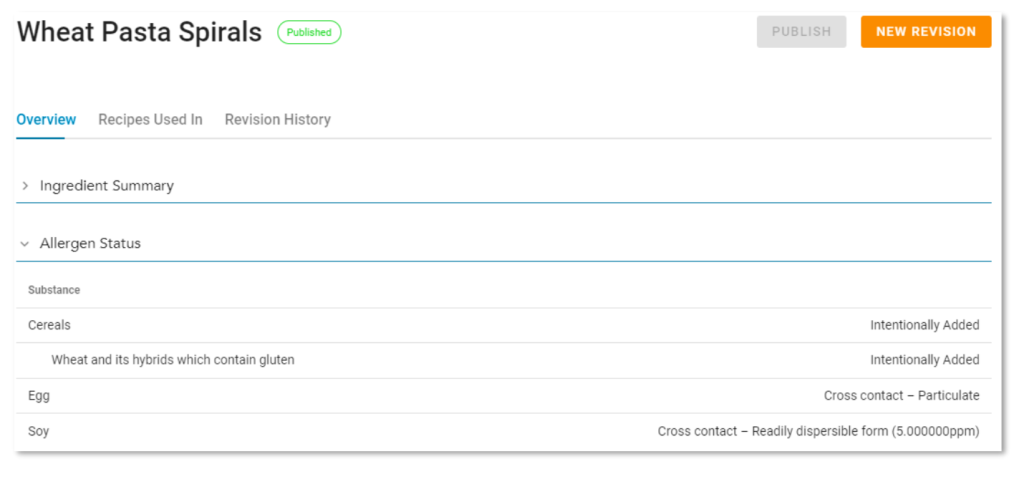
| Soybeans | Cross contact – readily dispersible (5ppm) |
Jack recorded all correspondence, calculations and decisions in his ingredient library files, and in VITAL Online. The summary of the information he entered into VITAL Online is shown in the snip below.
An ingredient supplier (regardless of whether they are local or international) must provide information that is necessary for the purchaser to comply with the allergen declaration requirements in the country of sale. It is recommended that a conversation is started with the supplier explaining allergen labelling requirements.
If you are experiencing difficulty obtaining concentrations of cross contact allergens, or information on particulates, other information may be helpful, such as batch sizes and the specific source of allergen, photo’s of agricultural cross contact. These can help to make an informed decision about the possible level of allergen cross contact in the product. See Report 6 FAO/WHO or Qualitative Approaches to risk assessment (insert link)
| Email to Supplier Hi Jill, Would you please confirm the allergens that are on the manufacturing site for ‘Ingredient X’ and how you can demonstrate that cross contact of these allergens does not occur. If possible please include data records such as cleaning validation procedure and results in your answer. |
| Email from Supplier Hi Jack, We have milk and soy on the site. These are managed according to our allergen management plan. Only soy is used on the same line as Ingredient X. We manage allergen cross contact by adhering to the allergen management plan, particularly effective is the use of scheduling and cleaning which is supported by validation and verification. I have attached a copy of our allergen policy for your records. |
Answer here
Every label must accurately display the allergen status of the product. Even if the task seems daunting, make a start. For example: Ensure for all new products you collect the information and centrally record the date of your review and the allergen risk rating you gave the material. Raw materials that you deemed to be a higher allergen risk can be reviewed more regularly than those you marked as low risk.
For existing raw materials consider the nature of the raw material, what you know about the supplier and the time since your last review to determine which ingredients should be prioritised for review. See Raw Material Approval in the Allergen Management Section.
TIP: Including this review as a part of your risk and vulnerability quality systems can save time and effort.